

Kyoto Prefectural Government Former Main Building
A timeless masterpiece, a work of art in architecture
This time, we introduce the Old Main Building of the Kyoto Prefectural Government, Japan’s oldest active government office building. It is located about a 20-minute walk or a 5-minute taxi ride from the Kyoto Hotel Kisho-tei Gosho-minami. This brick Western-style building served as the main hall of the Kyoto Prefectural Government from its completion in 1904 until 1971 (Showa 46). Parts of it are still used as offices today.
While built in the Renaissance style, it incorporates Japanese elements and superb traditional Japanese techniques. Its beauty is often described as resembling a work of art.
Important Cultural Property
The Former Main Building of the Kyoto Prefectural Government Office was designated an Important Cultural Property in 2004. It is recognized as a genuine Renaissance-style building designed by a Japanese architect and served as a model for prefectural government office architecture after the Meiji period, particularly for its integrated assembly hall.
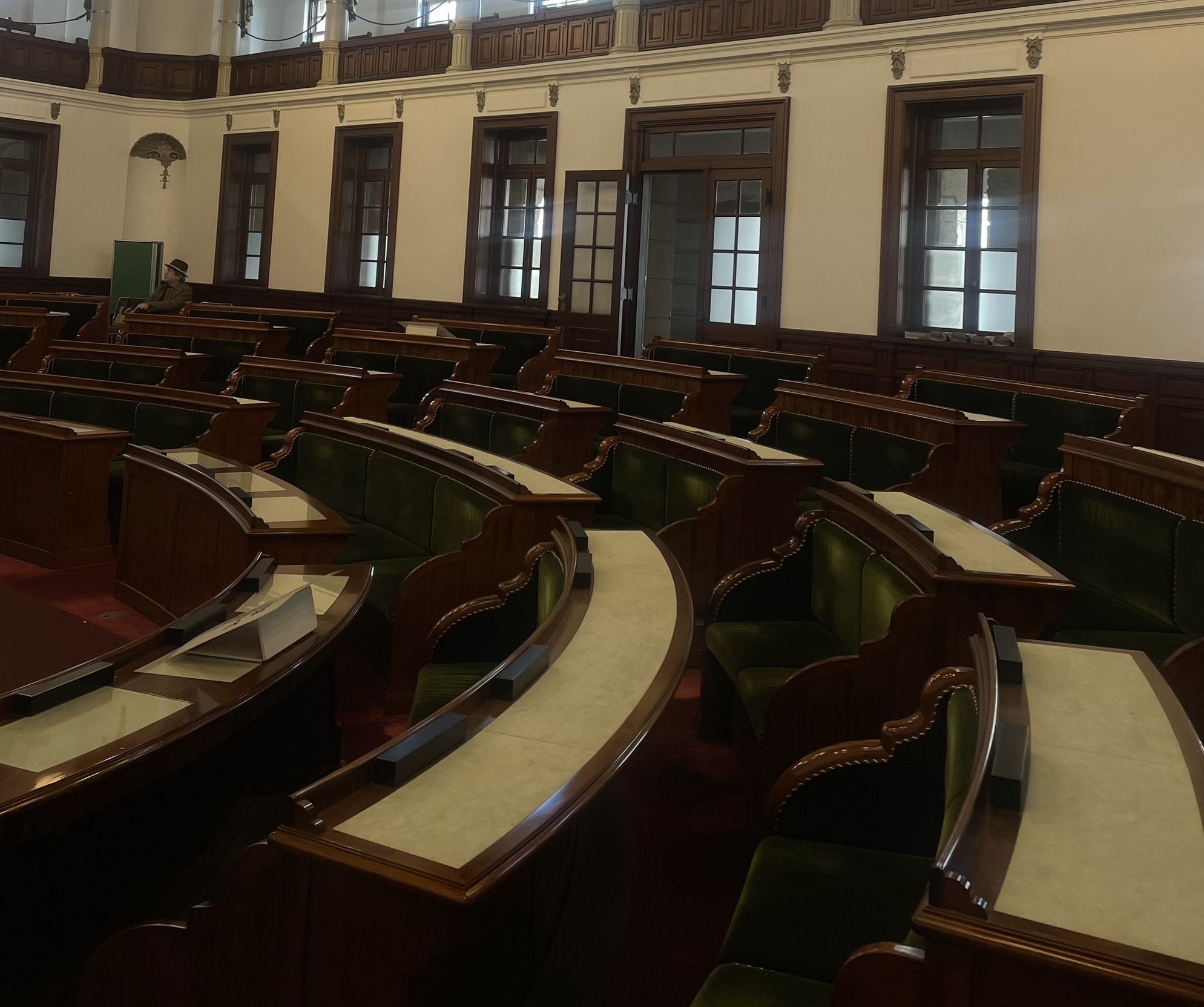
Rooms currently open to the public within the former main building include the Main Hall, the Former Governor’s Office, and the Former Assembly Hall. The Main Hall, a symbolic room where numerous official events and ceremonies have been held, features a prestigious coffered ceiling. It is said that the famous cosmonaut Yuri Gagarin was welcomed by the citizens of Kyoto from the balcony of this very room. The Former Assembly Hall was restored to its original appearance during the 110th anniversary of its completion. It is a space full of highlights, including the arched arrangement of the assembly seats and the decorated plaster walls.
Additionally, the reliefs found throughout the Old Assembly Hall and the building are said to be based on the “acanthus” flower. Alongside its floral meanings of ‘art’ and “architecture,” it also symbolizes an “unbreakable bond.” Perhaps these reliefs were crafted to represent the wish for an unbreakable bond between the people of Kyoto Prefecture and the prefecture itself.
Cherry Blossom Viewing Festival
The Old Main Building of the Kyoto Prefectural Government hosts an annual “Cherry Blossom Viewing Festival” when the blossoms are at their peak. Centered around viewing the six varieties and seven trees blooming in the courtyard, including the “Gion Weeping Cherry” and “Yasumasa Cherry,” the festival features stage performances, exhibitions, and tea ceremonies. Among the cherry trees at the Old Main Building, the large central tree is particularly striking. It is a seedling weeping cherry, a descendant of the original “Gion Weeping Cherry” from Maruyama Park. Standing beside it is the “Katamori Cherry,” a rare variety combining characteristics of the Oshima cherry and the mountain cherry, named after Lord Matsudaira Katamori. Its name is said to derive from the fact that the site where the former main building of the Kyoto Prefectural Office stands was once the location of the Kyoto Shugoshoku’s upper residence. At night, visitors can also see the cherry trees illuminated by lights.
From Kishōtei to the Former Main Building of the Kyoto Prefectural Office
It’s about a 20-minute walk straight from Kishōtei, and along the way you can stop by Kyoto Imperial Palace and Kyoto Imperial Palace Garden. Within the Imperial Palace grounds, numerous cherry trees sway their leaves. If you visit the Kyoto Prefectural Office during cherry blossom season, this is a spot we highly recommend stopping by. Of course, even outside of cherry blossom season, the Imperial Palace offers diverse scenery throughout the four seasons.
True to our name, “Kyoto Hotel Kisho-tei Gosho-minami,” we welcome you in a location close to the Imperial Palace, a historic stage of Kyoto.
salon de 1904
This attached cafe allows you to enjoy meals in a space featuring desks and chairs used during the Prefectural Office era, along with its distinctive white walls and red carpet. It is operated by Kyoto’s renowned Maeda Coffee, established in 1971. Here, you can savor coffee beloved by Kyoto residents for half a century within a cultural facility that has also long supported Kyoto. Furnishings are displayed throughout the shop and in the showcase, where you can find the “Occupied Japan” mark. Occupied Japan refers to the “MADE IN OCCUPIED JAPAN” mark affixed to export goods during Japan’s occupation by the Allied Forces to indicate its status as an occupied nation. Because these were export items, those remaining domestically are highly rare. Their historical context also makes them extremely valuable and popular antiques.
Recommended by the Writer
Inside the adjoining cafe, salon de 1904, you’ll find furniture like tables and cabinets bearing certain stickers. Square stickers labeled “Kyoto Prefecture” beneath items like “Product Name” are reportedly affixed to pieces actually used during the building’s time as the main hall. Enjoying the cafe while imagining Kyoto of that era might offer a quiet, delightful moment.

nimo
カフェや建築をよく巡っています☕︎