

A Stroll for Reflection
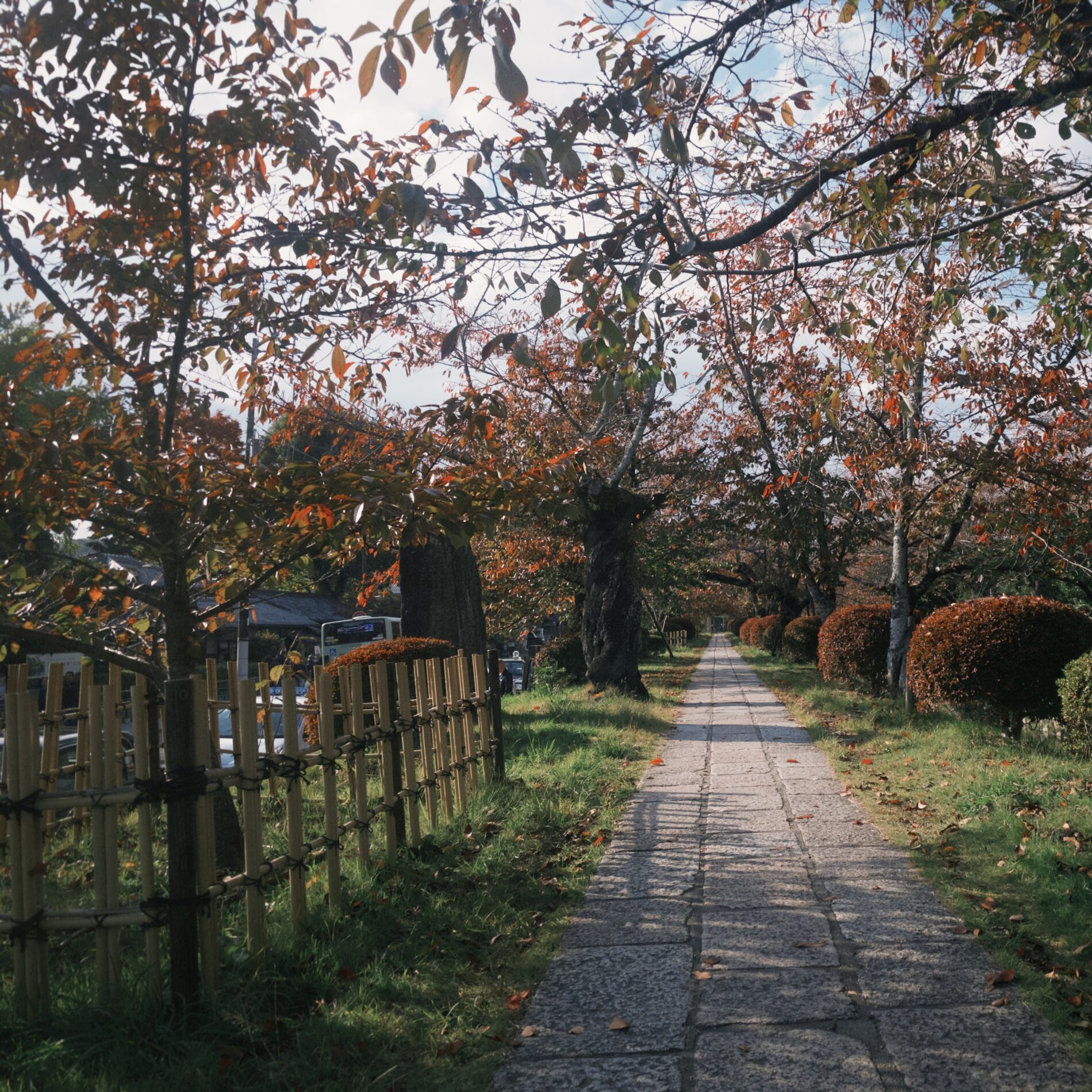
This time, I’d like to introduce Tetsugaku-no-michi (the Philosopher’s Path) in Sakyo Ward, Kyoto. The Philosopher’s Path is a small walking trail of about 2 km, running alongside a branch of the Biwako Canal from Ginkakuji-michi to Wakōji. Here, I’ll suggest a pleasant walking route: start from the “Ginkakuji-michi” bus stop, follow the Philosopher’s Path, and make your way to Ginkaku-ji (the Silver Pavilion).
The Philosopher’s Path and “Kansetsu Zakura”
The path is named after an episode involving Nishida Kitarō, the philosopher best known for his book An Inquiry into the Good and for establishing his own original philosophy. It is said that he walked this route every morning, lost in thought. Along the way, you can also find a stone monument engraved with a waka poem composed by Nishida.
In spring, the trail becomes a stunning tunnel of cherry blossoms. These cherry trees are known as “Kansetsu Zakura.” The name comes from Hashimoto Kansetsu, a Japanese-style painter who once lived near Ginkaku-ji. He is said to have donated the cherry trees as a gesture of gratitude to Kyoto, the city that supported him through difficult times.
Along the Philosopher’s Path you’ll also find the Hakusasonso Hashimoto Kansetsu Garden & Museum, where you can view Kansetsu’s works, his large studio, and a strolling garden built around a pond.
This is a walking path beloved by Kyoto locals—lined with cherry blossoms in spring. Take off your earphones, slip your phone into your pocket, and walk while letting your mind wander through the many ideas around you.
GOSPEL
On your way from the bus stop toward Ginkaku-ji via the Philosopher’s Path, try taking a small detour—you may come across a café called GOSPEL.
Housed in a spacious, classical Western-style building influenced by Vories architecture, it’s a place where you can enjoy a meal surrounded by antique furniture. Vories buildings are especially well known in Omihachiman (Shiga Prefecture), and in Kyoto, Tōkasaikan (the main restaurant building) is often cited as one example of that architectural lineage.
Open the door and walk up to the second floor, and you’ll find a hall-like space with high ceilings. The light that filters in—never too bright—reflects softly on the floor, giving the room a subtly fantastical atmosphere. Tables, chairs, and sofas vary in height and style, and each seat offers a different feel—so much so that you may find yourself thinking, “I want to come back just to sit somewhere else next time.”
Just like its dreamy ambience suggests, the café is wonderfully quiet—perfect for a thoughtful pause during a reflective walk. It lets in light without being overly bright, and feels elegant without being noisy or overwhelming. If you’re looking for a place to sit down and let your own philosophy unfold, this is a space worth visiting.
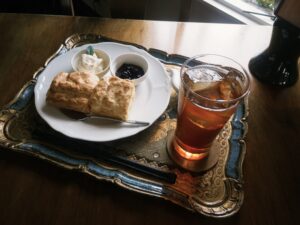
My recommended order is the scone set: beautifully baked scones that feel soft enough to crumble at the touch, served with cream and blueberry jam.
Jishō-ji (Ginkaku-ji) and the Silver Pavilion
Known popularly as Ginkaku-ji (the Silver Pavilion), its official name is Higashiyama Jishō-ji. With the Kannon Hall (often called the “Silver Pavilion”), the main hall, and its garden, the temple offers a beautiful glimpse into Higashiyama culture, where wabi-sabi aesthetics—quiet refinement and understated beauty—are treasured.
As you enter the grounds, you can view the Kannon Hall from the front. It’s well known that Ginkaku-ji is not actually silver, but seeing it in person, you’ll notice how it carries a dignified presence despite its lack of showy brilliance.
Following the designated route, you’ll walk through the garden and gradually climb up steps along the hillside. From above, you can look down at the second floor of the Kannon Hall through the trees—and if you climb a bit higher, you’ll be rewarded with a view of both the pavilion and Kyoto’s cityscape beyond.
On the way back down, the path gives you the chance to admire the pavilion from angles opposite to where you first saw it. Near the end of the route, you can even find a spot where the phoenix on the roof is especially easy to see. The layout is designed so you can experience the Silver Pavilion from many perspectives, without missing any of its charm.
The garden is scattered with trees, stones, and moss—if you can, take time to look closely at each element. At first glance, it may seem like the moss simply spreads across the ground, but when you step closer, you’ll notice an astonishing variety in its length, shade, and shape. It’s said there are more than 100 types of moss here.
Bright yellow-green moss, deep emerald moss, moss that looks fluffy like tiny leaves—countless varieties overlap to create a beautifully layered green carpet.
These days, you can easily find stunning photos on social media without ever visiting. But the wabi-sabi you can only feel by being there in person—by walking, stopping, and looking closely—may be one of the true joys of travel. And that quiet sensibility might just bring a new breeze to your own reflections on this thoughtful walk.
Writer’s Recommendation
After you enter the temple grounds and walk a short distance, you’ll see two famous sand formations: Kōgetsudai and Ginsadan. Up close, their scale and depth are impressive, and they add to the solemn atmosphere of Jishō-ji.
But what stayed with me most was the view from higher up the slope. As you climb the hillside steps and look down, Kōgetsudai and Ginsadan appear with an even stronger interplay of light and shadow, making the contrast feel sharper and more striking.
The way the impression changes depending on where you stand—that, to me, is part of the enduring fascination of Higashiyama culture, loved for centuries.

nimo
カフェや建築をよく巡っています☕︎