

A Pale-Pink Path by the River
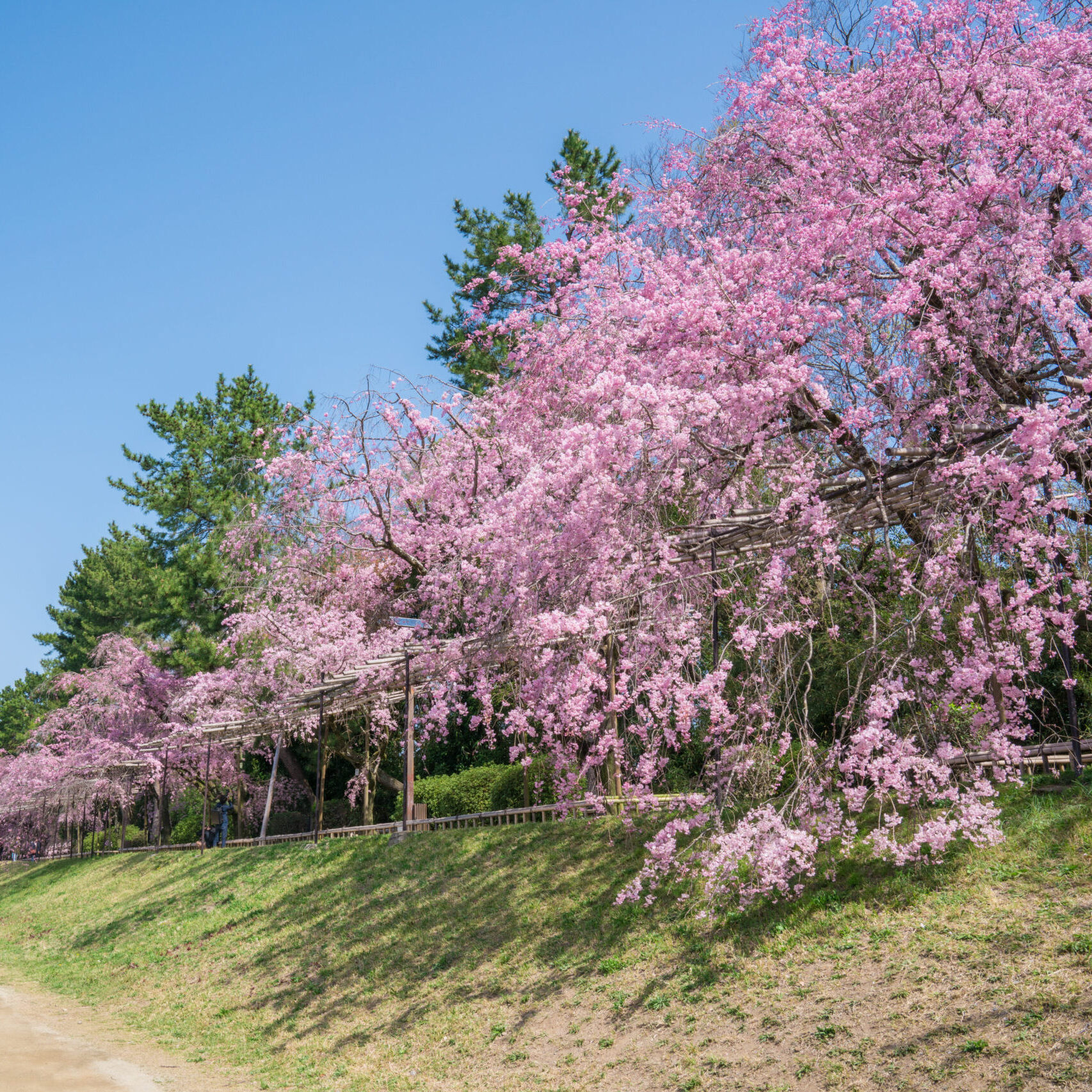
This time, I’d like to introduce Nakaragi-no-michi (the Nakaragi Path) in Kamogawa Park, one of Kyoto’s most elegant cherry blossom promenades.
Lining the quiet banks of the Kamo River, the double-flowered weeping cherry trees (yae-beni-shidarezakura) create a soft pink tunnel that appears only in spring. Because it’s a little removed from Kyoto’s busiest sightseeing areas, you can enjoy a calm, unhurried stroll. It’s wonderfully photogenic, of course—but it’s also the perfect spot for anyone who wants to savor the season at a slower pace.
If you’re hoping to step away from the city’s hustle and spend a gentle spring afternoon, this is a place I truly recommend.
Stepping Into the Blossoms
What makes the cherry blossoms here special isn’t simply looking up at them—it’s the feeling of stepping into the blossoms.
Rather than stretching high overhead, the branches drape softly downward, almost as if they’re wrapping the walkway in a delicate curtain. The petals sway right in front of you—slightly deeper in color than Somei Yoshino—layered and lush, with a fuller, more dramatic beauty.
Some people raise their cameras to capture the moment; others sit on a bench and simply watch the river flow by. Everyone spends time at their own pace, and in this place, a quiet kind of spring seems to drift along with the water. You may find yourself thinking, “I want to photograph this,” and at the same time, “I want to just keep looking.” It’s the kind of scenery you want to store gently in your memory—something that feels uniquely Nakaragi-no-michi.
The Name “Nakaragi” and the Story Behind It
As you walk, it might be nice to pause and think about the name “Nakaragi” (written as 半木).
It’s said that this area was once associated with a shrine called Nagaragi Shrine, named after a sacred tree that had drifted here. Later, to avoid the negative association of the character suggesting “being washed away” in floods, the character “half” (半) came to be used instead.
The beautiful rows of weeping cherry trees you see today were also shaped over time—carefully tended and gradually cultivated by local residents since the 1970s.
The peaceful view we enjoy now exists because of the people who loved this place and continued to care for it. Walking with that thought in mind makes the scenery feel even more meaningful.
If You Feel Like Walking a Little More
If you finish Nakaragi-no-michi and still want to linger in the spring mood, try extending your walk along Kamosai-dori, from Kitayama Bridge to Misono Bridge.
Here, Somei Yoshino blossoms fill the branches and form a bold, powerful tunnel of cherry trees—almost as if the sky itself is covered in flowers. It’s a striking contrast to the graceful elegance of Nakaragi-no-michi, and you may be surprised at how different the atmosphere can feel along the same river.
