

— A Gaze That Looks Back, Shaped by Gentle Compassion
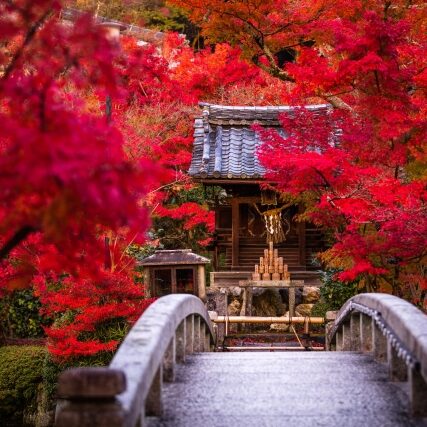
This time, I’d like to introduce Eikandō, one of Kyoto’s most celebrated spots for autumn leaves. Its official name is Zenrin-ji Temple, a distinguished temple nestled at the foot of the Higashiyama mountains. Originally founded as a center for esoteric Buddhism, it later became a place devoted to Pure Land nembutsu practice, led by the monk Eikan.
From Kyohotel Kishotei Goshominami, it takes about 30 minutes by bus and on foot. It’s the kind of place I especially recommend visiting during a trip—when you might feel yourself rushing—because it gently reminds you how to slow down, walk with care, and carry kindness toward others.
The “Mikaeri Amida” (The Amida Who Looks Back)
Eikandō’s principal image—an Amida Nyorai standing statue—has an unusually distinctive pose: it turns its head to look back over its left shoulder.
According to legend, as Eikan devoted himself to nembutsu practice and walked in ritual procession, the Amida statue descended from the altar and began to lead him forward. Eikan, stunned, stopped in his tracks—at which point Amida turned back and said, “Eikan, you are slow.”
It is said that Eikan wished to preserve this deeply compassionate姿 for future generations, and thus the statue has been passed down to us as the Mikaeri Amida. True to the story, the expression on its face—looking back over its shoulder—is remarkably gentle.
Because of this legend, the Mikaeri Amida is often associated with meanings such as compassion for those who suffer, and offering care and kindness to others.
Perhaps what we can learn from it is not “looking back for the sake of the past,” but looking back with compassion—so we can move forward together with someone else. Even when we’re busy and constantly moving, we can pause to reflect on the people around us—and, ultimately, on our own hearts. In modern life, that may be one of the most powerful messages this statue offers.
Harmony with Nature
As you look around Eikandō, you’ll notice how the buildings seem designed to blend into nature rather than stand apart from it. One of the highlights is the Garyūrō (the “Reclining Dragon Corridor”), a beautifully crafted wooden walkway built along the mountain slope. It feels less like humans are controlling nature, and more like people are gently living alongside it—an architecture of quiet beauty and kindness.
If Nanzen-ji can be likened to the “Less is more” philosophy often associated with Mies van der Rohe, then Eikandō might be described in the spirit of Kengo Kuma’s “architecture that yields”—architecture that doesn’t insist on “winning,” but instead teaches us that there are other, gentler ways to exist. It’s a wonderful structure that seems to whisper that “winning” isn’t the only answer.
Eikandō’s “Seven Mysteries”
Eikandō is also known for its traditional “Seven Mysteries.” The Garyūrō is one of them—said to be assembled without using a single nail, which is why it’s counted among these wonders.
If you’re looking for something that feels even more like a mystery, there’s the story of the “Nuke Suzume” (the Escaped Sparrow). The sliding doors in the “Peacock Room” were originally painted with five sparrows—but one is said to have flown away like a real bird, leaving only four behind. Since sparrows have long been regarded as sacred in Japan, that sense of reverence may be part of why such a legend has been preserved.
There are many other stories as well: the Hiden-ume, a plum tree with only one remaining trunk; the Sankō no Matsu, a pine with three needles; and tales such as Iwagaki Momiji and Mokugyo Kaeru. Exploring the grounds while searching for each legend—and learning the origins behind them—adds a playful layer of depth to your visit.
Writer’s Highlight: “Eikandō, the Temple of Maple Leaves”
Eikandō is so famous for its autumn colors that it has even been praised as “Eikandō of the autumn leaves” in classical poetry. In fall, around 3,000 maple trees across the grounds turn brilliant shades of red and gold, creating a dreamlike landscape that lasts only a few precious weeks.
One especially breathtaking view is the Tahōtō Pagoda on the hillside, surrounded by glowing maples. Combined with the panoramic view over Kyoto, it’s truly unmissable.

nimo
カフェや建築をよく巡っています☕︎