

Zen: The Essence of Minimalism and Encountering the Depth of Time
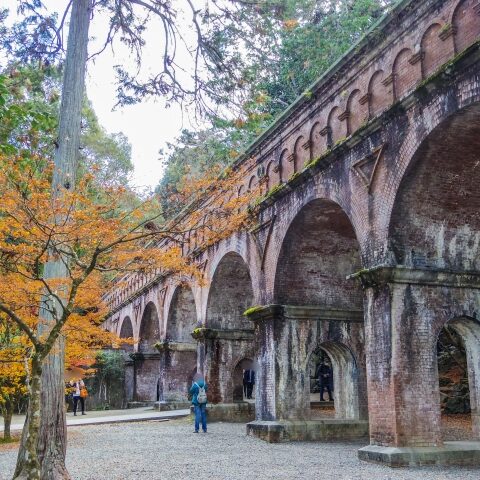
This time, we introduce Nanzen-ji Temple, a representative Zen temple of Japan located in Kyoto’s Higashiyama area. Founded in 1291 by Emperor Kameyama, Nanzen-ji has long been cherished as a Zen temple. Stepping back from daily life to spend time in quietude, calming the mind. Isn’t this precisely the “luxurious moment” we need in our busy modern lives?
Crossroads of Time – Suigokaku
As you walk through the grounds of Nanzenji, the Suigokaku, with its striking red brick arches, comes into view. Built during the Meiji era, this structure is part of the canal system that channels water from Lake Biwa into Kyoto City. You might be surprised to see such a distinctly Western-style building suddenly appear within a Zen temple. Yet, this very contrast is part of Nanzenji’s unique charm. It symbolizes the temple’s distinctive path: rather than discarding the old to build the new during Japan’s modernization, it has chosen to layer elements from different eras upon each other. Here, you can sense the Japanese spirit of “learning from the past to understand the present.”
Zen Aesthetics and Minimalism
Nanzen-ji features the “Hōjō Garden,” a representative dry landscape garden from the early Edo period; the “Small Hōjō Garden,” also known as the “Jōshin Garden”; and the “Rokudō Garden,” representing the spirit of admonition. The Hōjō Garden is also known colloquially as the “Tiger Cub Crossing” garden and is designated a National Scenic Spot. The Small Hōjō Garden is likewise a dry landscape stone garden, with stones arranged in the shape of the character “心” (heart). It is a Zen garden with a serene atmosphere, like a liberated mind.
From the “negative space” felt in these gardens, one can learn the beauty of “nothingness.” Thinking in more contemporary terms, this resonates with the “Less is more” aesthetic seen in the work of one of the world’s three greatest architects, Mies van der Rohe. In the gardens of Nanzen-ji, one can sense this spirituality sought by modern minimalism: “by placing nothing, one can feel many things.”
From Kisho-tei to Nanzen-ji
The charm of Nanzen-ji lies in the experience of “stillness” it embodies. Accessible from central Kyoto, it is enveloped in a particularly serene atmosphere during quieter times like early morning or evening.
Departing Kisho-tei in the morning and having breakfast nearby, take the subway to Keage Station. From there, a 15-minute stroll through nature brings you to Nanzen-ji. The area around Karasuma Oike offers a stark contrast, a calming zone where one’s pace naturally slows.
Nearby, modern cafes like Blue Bottle Coffee line the streets, allowing you to savor Kyoto’s unique blend where tradition and modernity resonate.
At Nanzen-ji Temple, you can experience more deeply the intellectual journey of “savoring the space of time” and “appreciating tranquility” that Kisho-tei offers its guests. The spirituality of Zen, the sculptural beauty of modern architecture, and harmony with nature. We invite you to visit Nanzen-ji Temple, where you can luxuriate in all these elements.

nimo
カフェや建築をよく巡っています☕︎